Citations feel fussy, but they exist for good reasons: they let readers trace your evidence, and they protect you from accidental plagiarism. The hard part is usually just knowing which style to use — and applying it consistently.
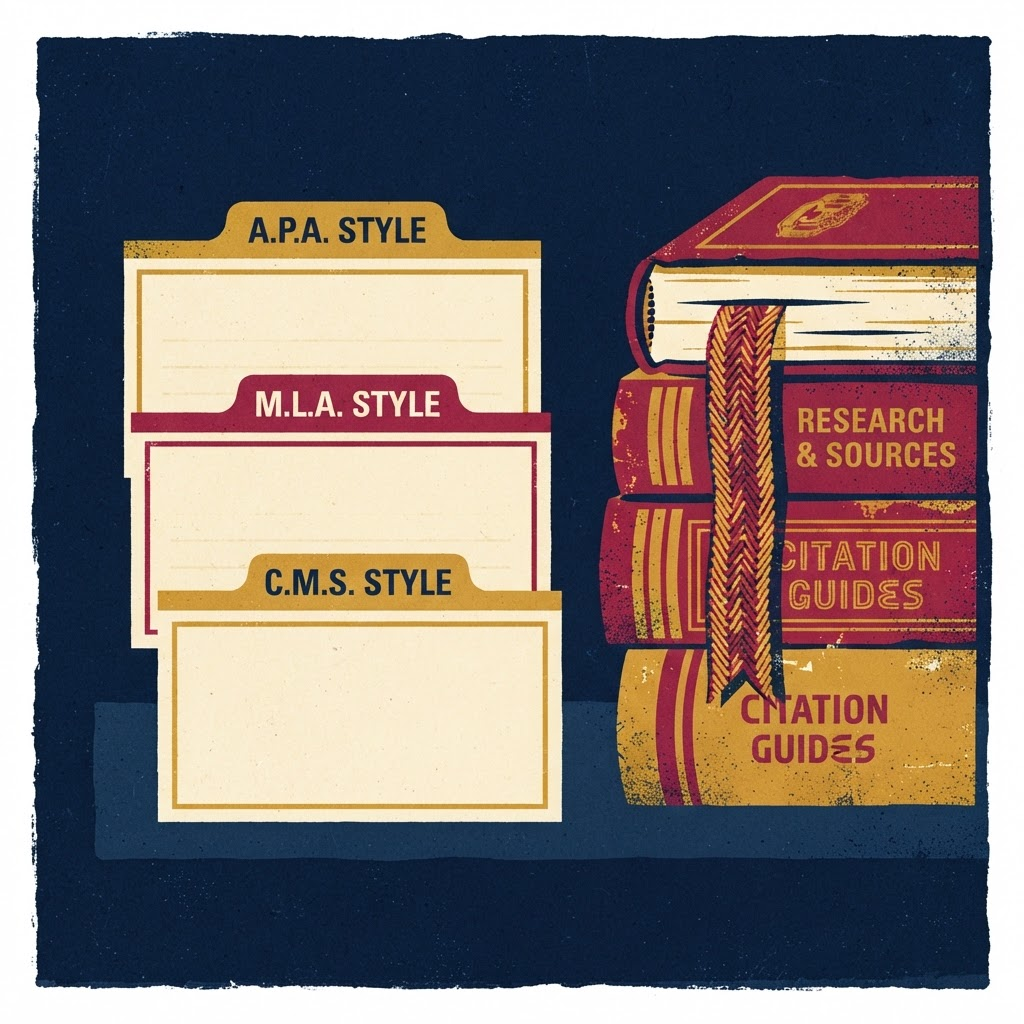
The short answer: your discipline usually decides. MLA is standard in the humanities, APA in the social sciences, and Chicago in history and the arts. Here is how to tell them apart and use them without second-guessing every comma.
MLA — the humanities
Used in literature, languages, and cultural studies. MLA uses an author-page in-text citation: (Morrison 42). The emphasis is on the exact location in the text, because close reading of specific passages matters.
APA — the social sciences
Used in psychology, education, nursing, and business. APA uses an author-date citation: (Morrison, 2019). The emphasis is on recency, because in these fields how current the research is often matters most.
Chicago — history and the arts
Chicago offers two systems. Its notes-bibliography system uses footnotes or endnotes and is preferred in history and the arts, where detailed source notes are common. Its author-date system works much like APA and appears in some sciences.
The style matters less than the consistency. Pick the one your assignment requires and apply it the same way every single time.
How to choose in ten seconds
- Check the assignment or syllabus — the required style is almost always stated.
- If it is not, use your discipline: humanities → MLA, social sciences → APA, history/arts → Chicago.
- Still unsure? Ask your instructor. It is a thirty-second question that prevents lost points.
Let AI check — never invent — your citations
This is the most important rule of the AI era. Large language models frequently fabricate plausible-looking citations — real-sounding authors, titles, and page numbers that do not exist. Vanderbilt's own guidance notes that AI tools can "hallucinate" and generate whole sources out of nothing.
So use AI safely:
- Ask it to check whether a citation matches the required format — not to produce sources.
- Verify every reference against the real source before you submit.
- Never cite a source you have not actually read.
Want to check your citations before you submit?
If you want a safe way to catch formatting errors and inconsistencies, The Citation Confidence Prompt Pack gives you guided prompts for MLA, APA, and Chicago that cross-check your in-text citations and reference list — designed specifically to avoid fabricating missing source details.
A quick example of the same source
MLA: (Morrison 42)
APA: (Morrison, 2019, p. 42)
Chicago, notes: a numbered footnote with full publication details the first time, shortened after.
Common citation mistakes
- Mixing styles. Choose one and stay consistent throughout.
- Trusting an AI-generated bibliography. Always verify each entry against the real source.
- Forgetting in-text citations. A works-cited page does not replace citing in the body.
Good citations start with good sources — see how to turn a broad topic into a focused research question, and make sure you know what your school's policy says about citing AI.
Frequently asked questions
Which style should I use if none is specified?
Default to your discipline's norm — MLA for humanities, APA for social sciences, Chicago for history — but confirm with your instructor when you can.
Do I need to cite AI if I used it?
If your course requires disclosure, yes. Both MLA and APA now publish guidance on how to cite generative AI.
Sources & further reading
- Purdue OWL — Research and Citation Resources: owl.purdue.edu
- MLA Style Center: style.mla.org · APA Style: apastyle.apa.org